NOVEMBER 9, 2026: Originally, I planned to write a single blog post about our two-day visit to Herne. But as we learned more about our family’s history, I realized there was too much to fit into one post. Two posts seemed sensible—one for each day. Then the discoveries kept coming. So our two-day visit has become a four-part Herne series.
We arrived in Herne on Sunday evening and reunited with my daughter, my son and my sister, who had come from the USA. After a good night’s sleep, our first stop on Monday morning was the Kulturzentrum Herne, the cultural center that houses the Herne City Archive.

At the city archive, we met historian Ralf Piorr, who has spent decades researching the town’s Jewish community, tracing families, interviewing former residents and restoring names and stories that had almost disappeared from local memory.
Ralf created Herne’s historical plaque project, which began in 2005, and he plays a central role in the town’s Stolpersteine project, whose first stones were laid this past January. He was also our main contact in arranging the installation of our family’s stones. After so much correspondence, it was wonderful to finally meet him in person.
We found him to be a rare gem: knowledgeable, bright, enthusiastic and warm, with a passion for his work that made us eager to hear more. It is hard to overstate how much he added to our visit, both through what he taught us and through the care he showed for our family’s history.
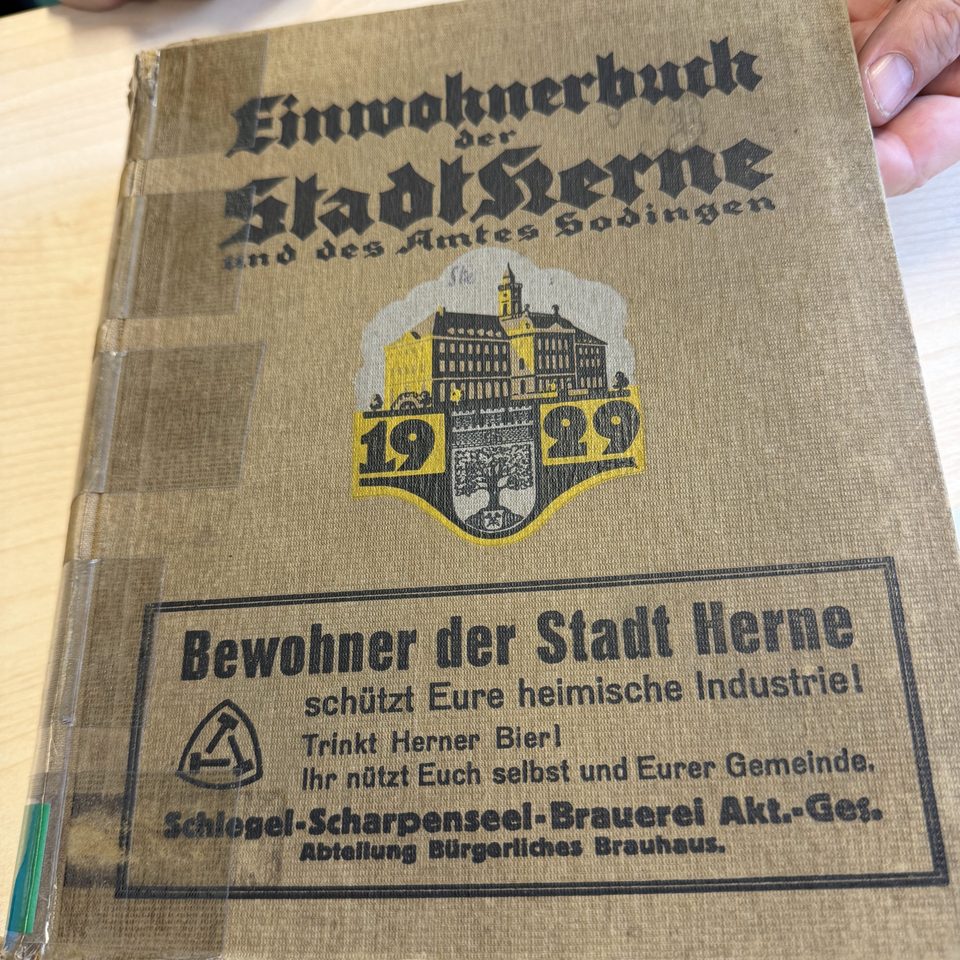
When we arrived at the archives, Ralf was ready with a large stack of address books. In the past, when you moved to a new town, you registered with the city hall, and about every two years, they published a directory of residents that included their name, their occupation and their address. Residents meant men – married women and children were usually not listed.
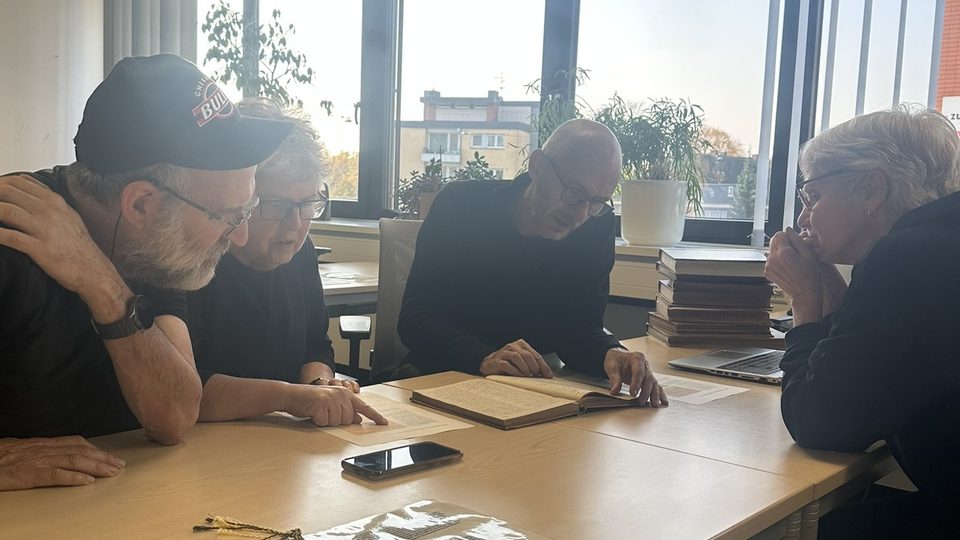
Ralf showed us how, by following entries from one edition to the next, we could trace our family’s life in Herne. There were no Feuersteins in the 1905–1906 directory. In the next volume Ralf showed us, Moritz Feuerstein—my great-grandfather, whom we called Opa—and Schulim Feuerstein appeared at the same address. From the timing of the directories, Ralf estimated that they had arrived around 1907.
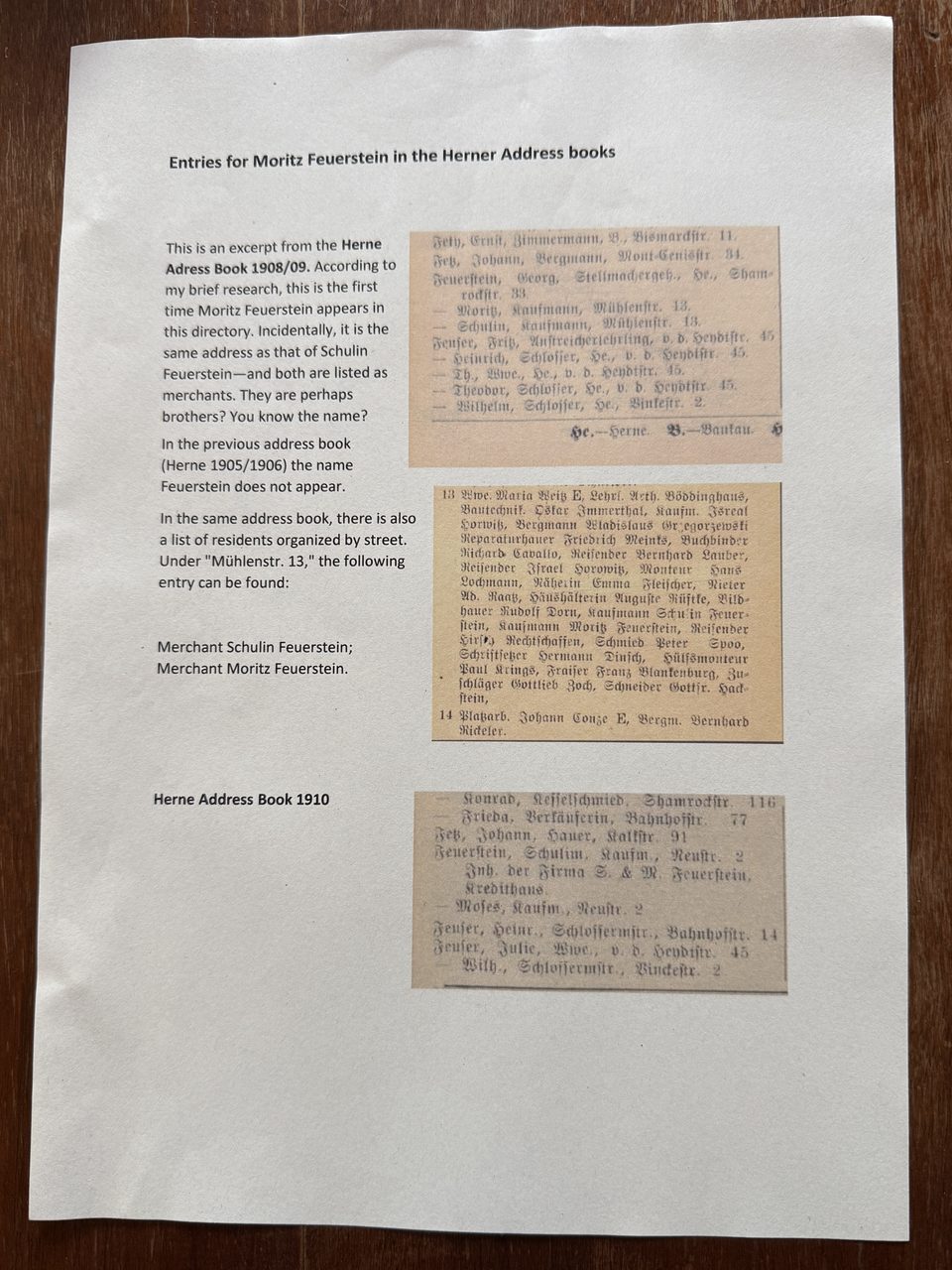
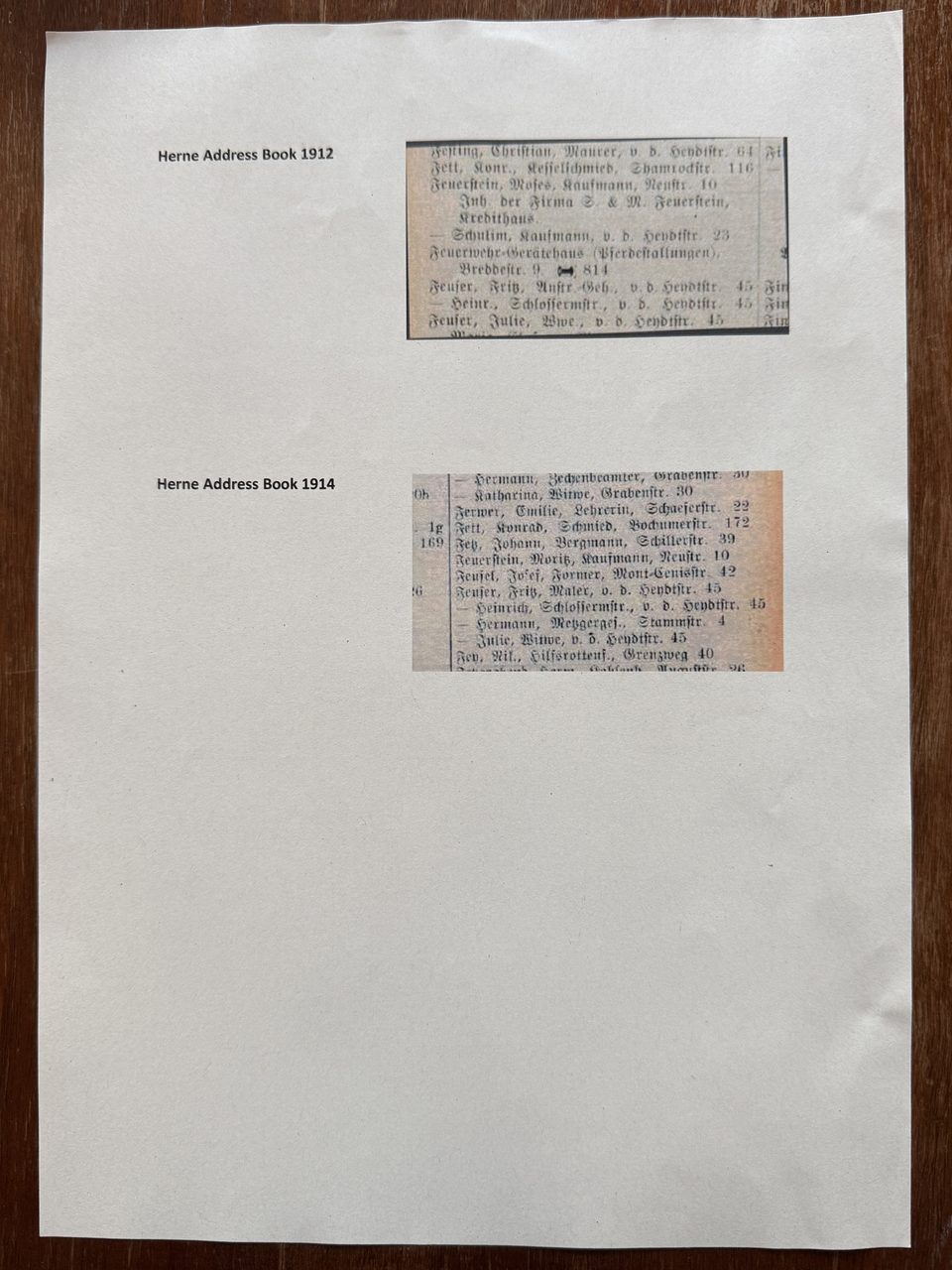
I had wondered whether Oma and Opa might have followed Oma’s brother, Isaak Bergwerk, to Herne. But the records suggested the opposite sequence: the Feuersteins were there well before the Bergwerks, who began appearing only in later directories.
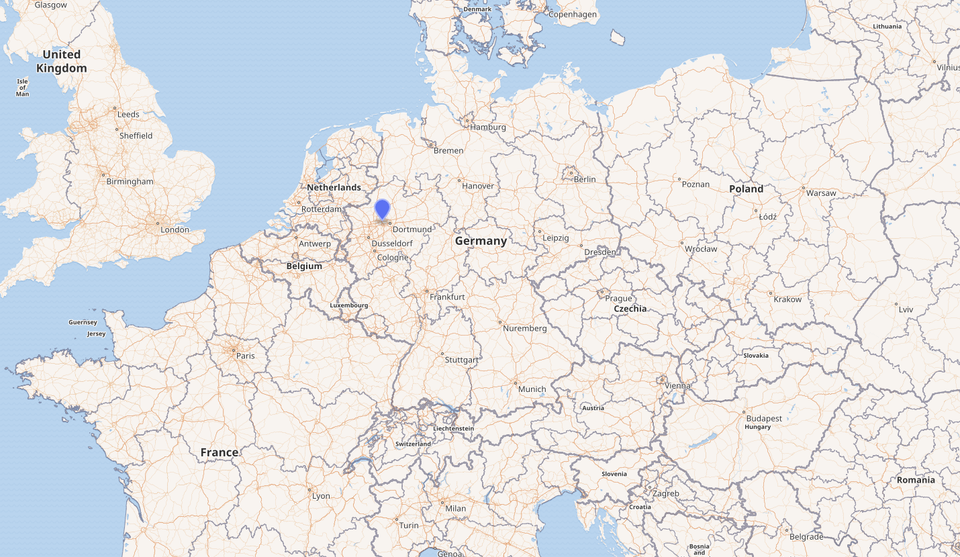
Why Herne? Located in western Germany, in the state of North Rhine-Westphalia, Herne had been transformed by the coal industry into a place of opportunity. The coal mines needed workers and the population therefore grew rapidly, and those workers and their families needed goods: groceries, clothing and furniture. Seeking prosperity, people came to the region from elsewhere in Germany and from even farther east, including Galicia, where Oma and Opa were born.
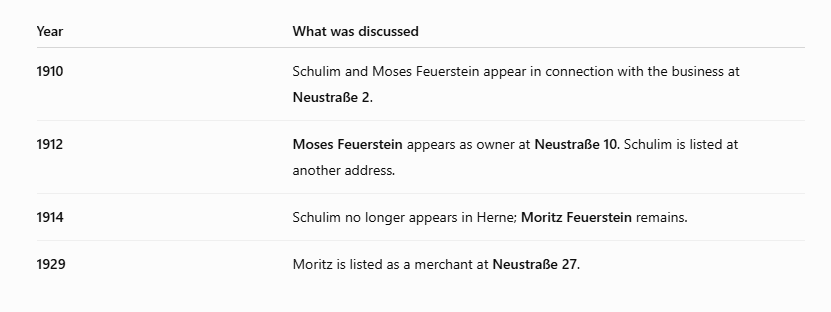
Schulim, known in the family as Shalom, was Opa’s uncle, although the two were relatively close in age. The 1910 directory linked both men to a business at Neustraße 2. By 1912, Moses Feuerstein—Opa, who was known as both Moritz and Moses—was listed as the sole owner at Neustraße 10. Schulim is listed at another address. By 1914, Schulim is no longer listed in Herne. These entries support the family story that Schulim originally owned the store, and Opa later took it over. The 1929 directory listed Opa at Neustraße 27, the address familiar to us and where we would be laying the memorial stones.
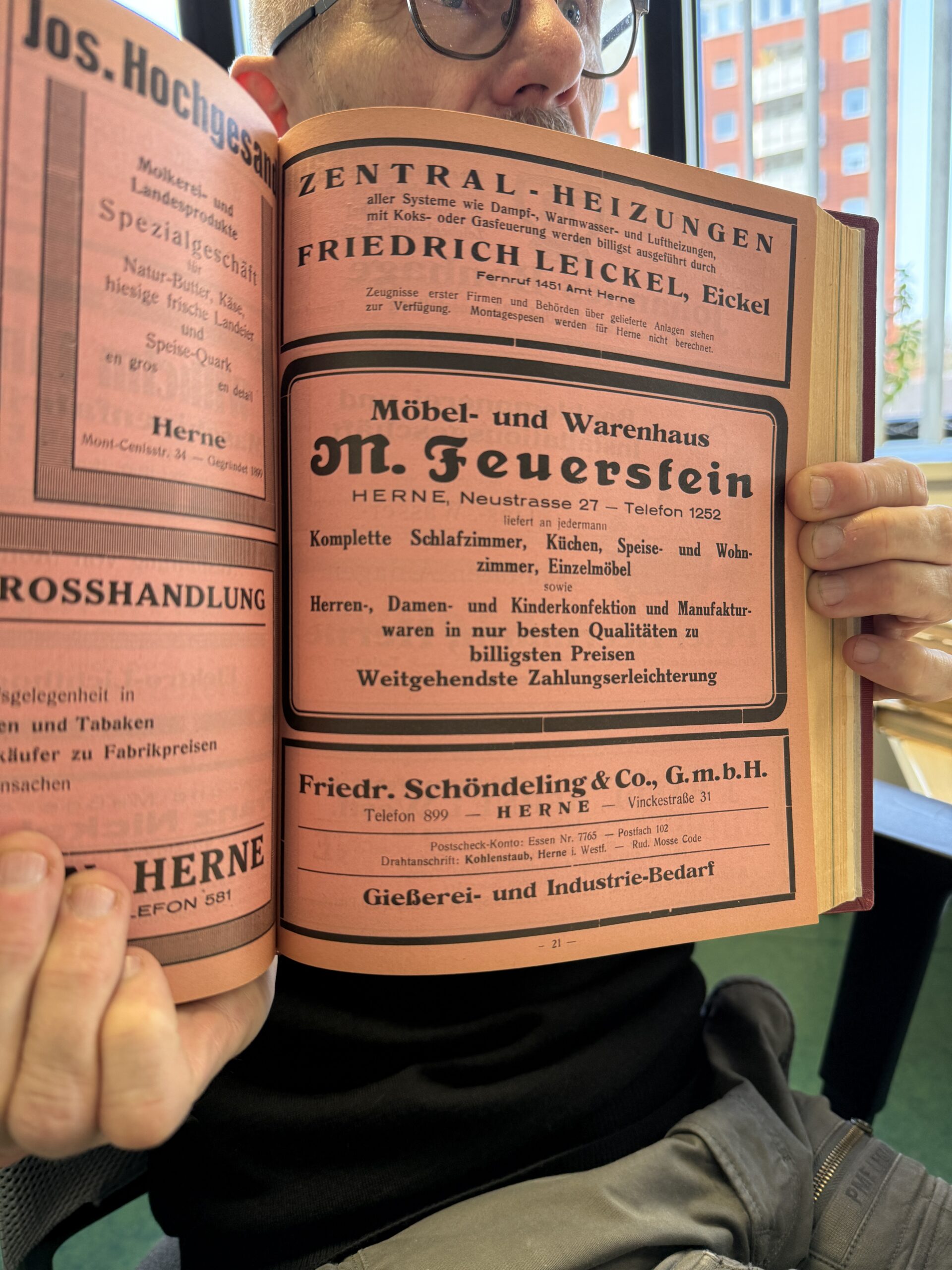
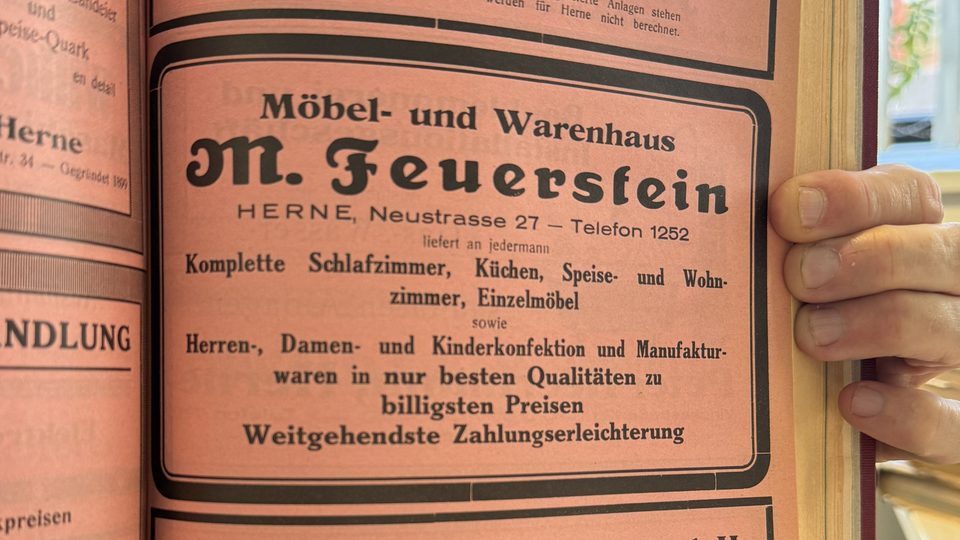
Then Ralf showed us an advertisement from the 1926 directory. Opa’s store advertised complete bedrooms, kitchens, dining rooms and living rooms. He was a merchant, Ralf explained, buying and selling furniture rather than manufacturing it himself.
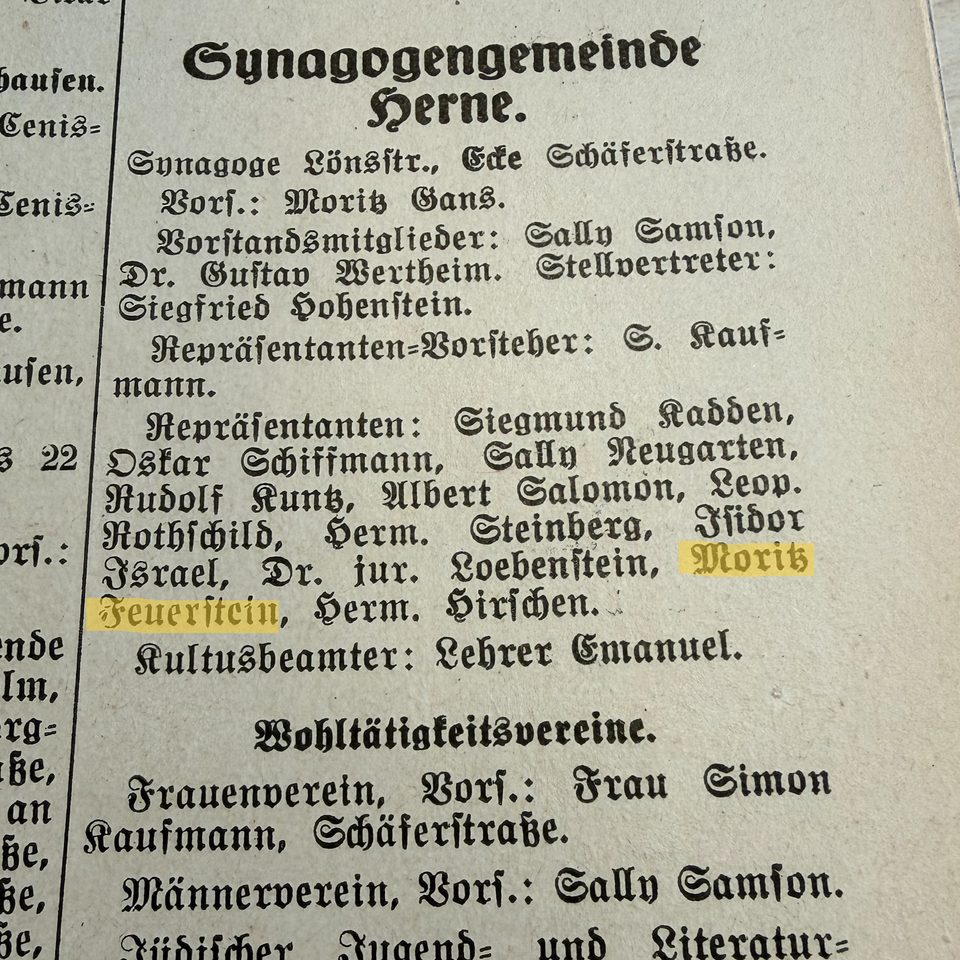
Ralf also found that the 1929 residents’ directory revealed something about Opa beyond his business. Under the heading “Synagogengemeinde Herne” – Herne’s Jewish congregation – Moritz Feuerstein was listed among the community representatives. Here was a record of his active involvement in the Jewish communal life of the town.
In a later directory, Opa’s address is listed as a 27 Franz-Seldte-Straße. This unfamiliar street name did not mean the family had moved, but rather in 1933, Neustraße was renamed Franz-Seldte-Straße, in honor of a prominent member of Hitler’s government. After the war, it became Neustraße again.
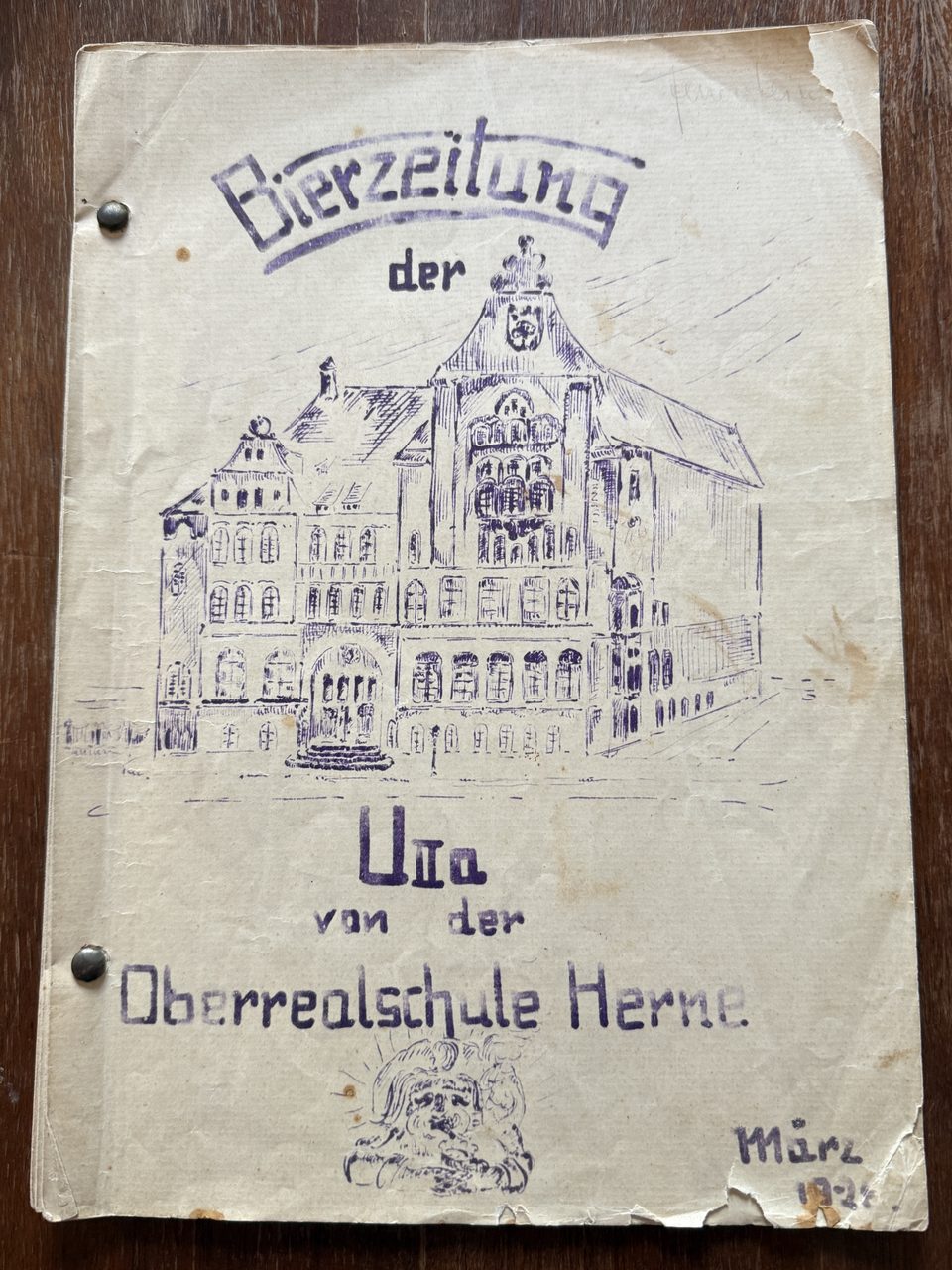
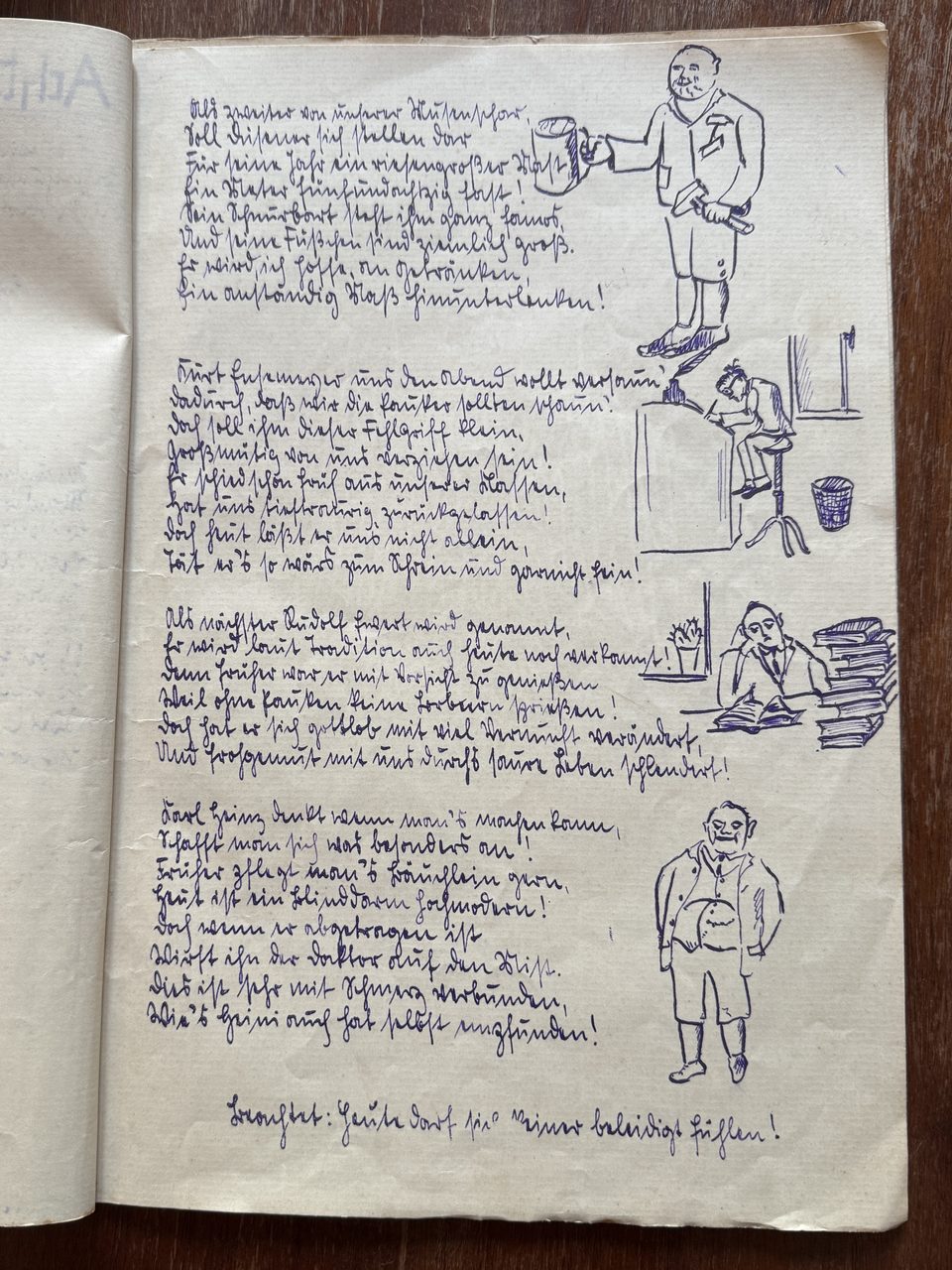
For our meeting, I had brought along some materials to show Ralf, including a copy of a Bierzeitung (literally “beer newspaper”) from March 1928, the year my grandmother Frieda (Sabti) finished high school. Ralf explained that this was a humorous graduation booklet filled with poems, jokes, and satire about teachers and classmates. The tradition of graduating students producing a magazine that affectionately pokes fun at school life continues until today, usually under the name Abizeitung.
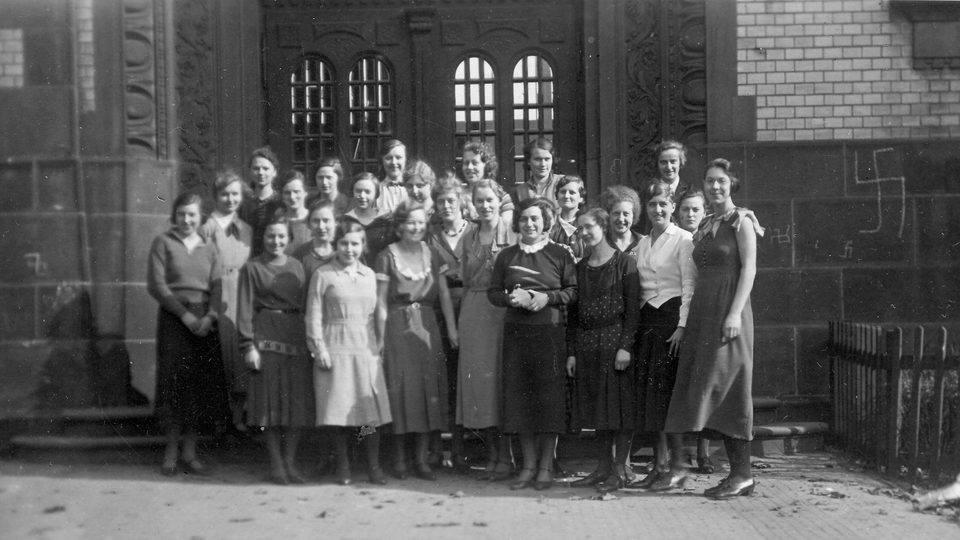
We also discussed a graduation photo of Hilde, Sabti’s sister, showing a group of girls standing in front of their high school in 1933. A swastika drawn on the building is clearly visible behind them. Among the girls was Hilde’s good friend Gerda Elias, whose daughter, Hanneke, we would meet later on today.
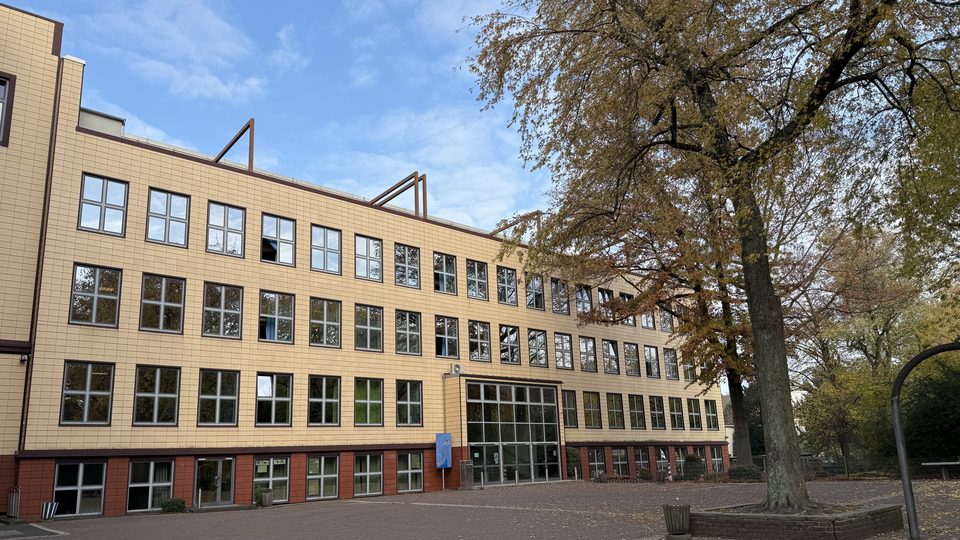
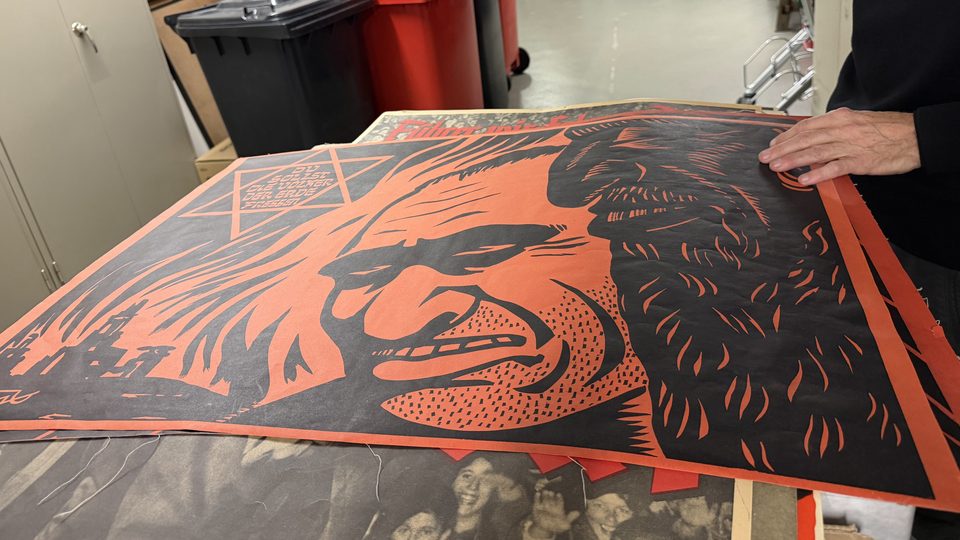
Ralf then took us to the basement of the Herne City Archive. The residents’ directories had helped us follow our family’s arrival and the development of Opa’s business in Herne. The political posters that followed showed us more of the world in which they lived. Ralf explained that these posters would have appeared in shop windows, offices and billboards, putting political messages into the spaces people passed through every day.
Some posters were openly antisemitic. For example, in this poster, the lettering inside the Star of David reads: “Du sollst die Völker der Erde fressen!” This means: “You shall devour the peoples of the earth!” It is an antisemitic propaganda slogan portraying Jews as a threat to all nations.
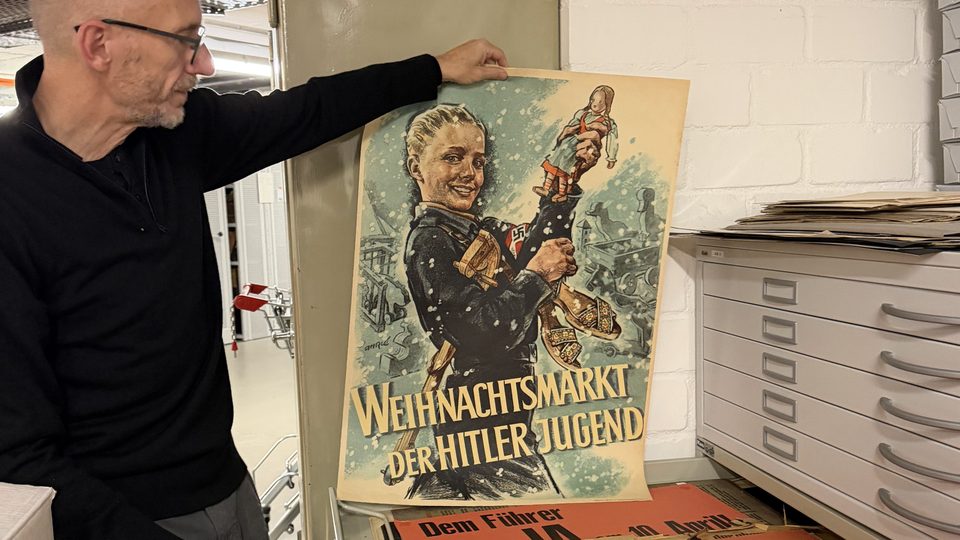
Other posters presented appealing images of German family life and belonging. Rolf pointed out how carefully the propaganda was designed. A swastika did not always need to dominate the picture; sometimes it was a small detail within an otherwise ordinary scene.
Ralf spoke about the Nazi idea of Volksgemeinschaft, a national community built around their definition of who belonged. Looking at the posters together, we could see how images promising unity worked alongside messages that excluded Jews.
This poster says “Weihnachtsmarkt der Hitler-Jugend” – “Christmas Market of the Hitler Youth.” It shows a smiling girl holding shoes and toys. Unlike the openly hateful poster, this uses a cheerful Christmas scene to associate the Hitler Youth with family life and German tradition, presenting an ideal of national life in which Jews had no place.
We then turned to the deportation lists. In 1933, Herne had a population of around 100,000 of which about 500 were Jews. Ralf explained several ways in which Jews were forced to leave the town.
During the November 1938 pogrom in Herne, many Jewish men—including Opa—were arrested and sent to Sachsenhausen concentration camp. In Germany, this event is now commonly called the Pogromnacht. The term “Kristallnacht,” with its reference to broken glass, is often avoided because it minimizes the violence against people and the destruction of Jewish life.
For a brief period, from late 1938 until the outbreak of war in September 1939, some families in Herne were able to send older children to safety in Britain and France through the Kindertransports. These departures saved lives, but meant parents sent their children away without knowing when—or whether—they would see them again.
Others managed to emigrate, as Oma and Opa eventually did.
For those who remained—mostly women with young children and elderly people—the deportations of 1942 brought a forced and final departure from Herne, effectively bringing the town’s Jewish communal life to an end.
From the archive shelves, Ralf pulled out a box labeled “Jewish Life in Herne.” Inside was a folder of deportation lists. On one of them, from July 29,1942, we found Oma’s brother, Isaak Bergwerk, and his wife, Hilde. Beside their names was a pink checkmark. Done.
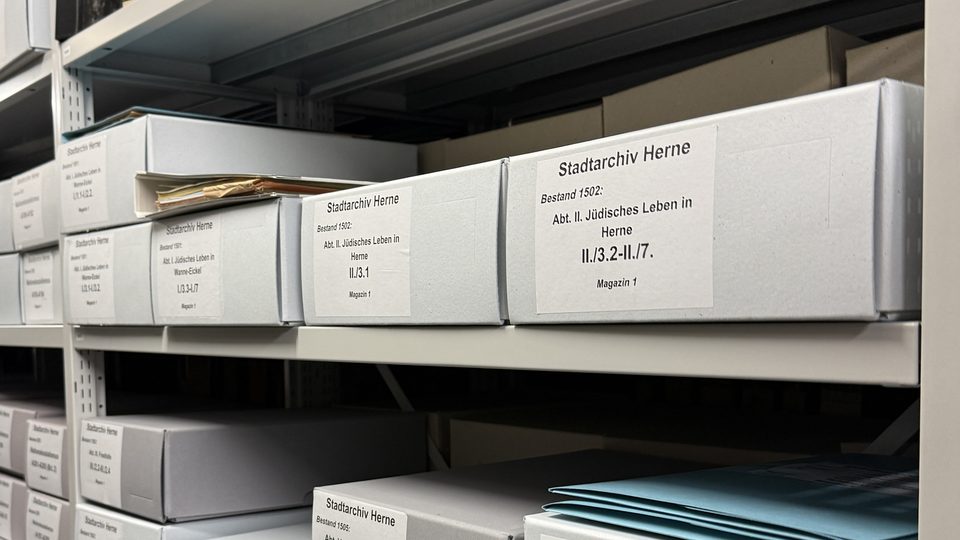
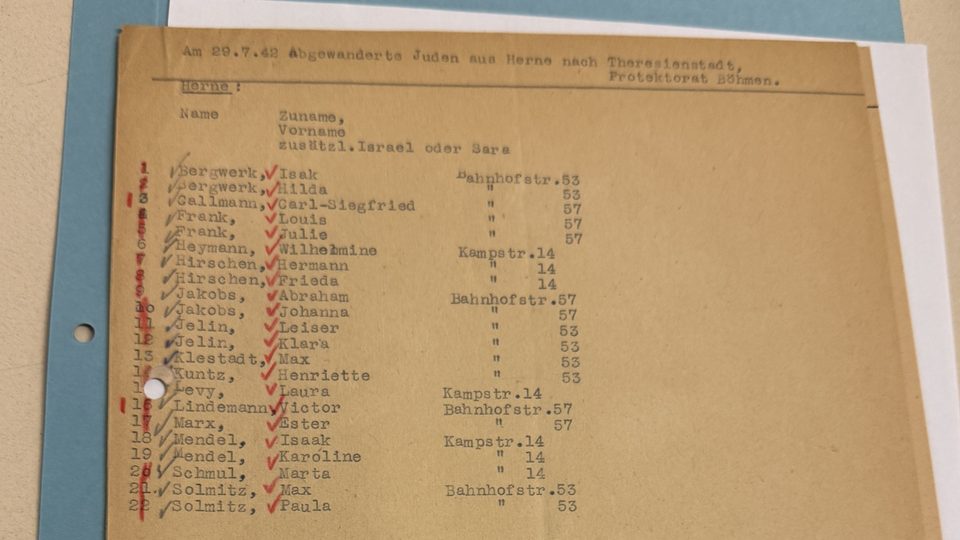
What caught our attention was their address: Bahnhofstraße 53, rather than Schulstraße 69, where we would lay their memorial stones the following day. Ralf explained that beginning in 1941, Jewish families in Herne were forced out of their homes and crowded into three designated buildings, known as “Judenhäuser,” or “Jewish houses.” Bahnhofstraße 53 was one of them.
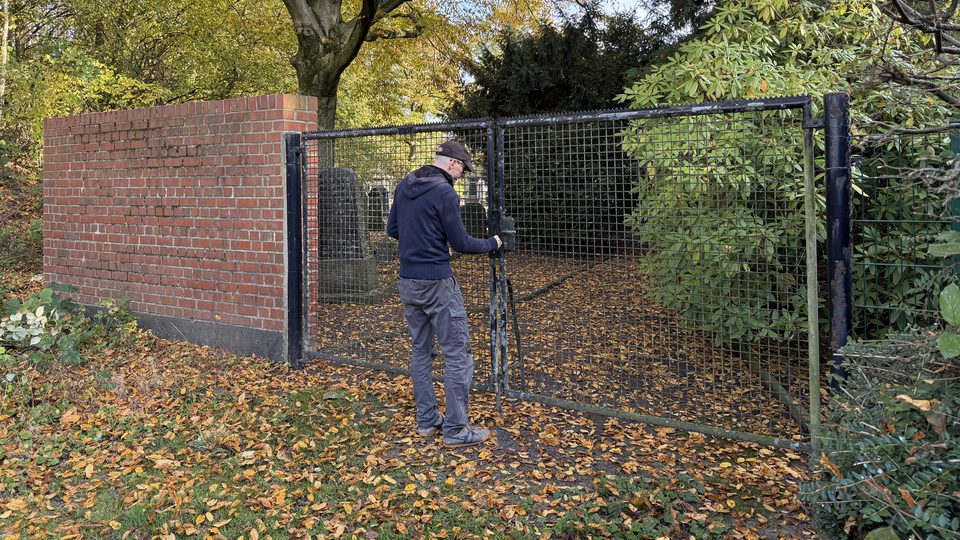
It was getting late, and we still had one more place to visit: Herne’s Jewish cemetery. Surrounded by a high wall and locked gates, it is not somewhere we could simply walk into, but Ralf had a key and would take us there. We hoped to find two particular graves: those of Oma’s two children who had died very young and were buried there.
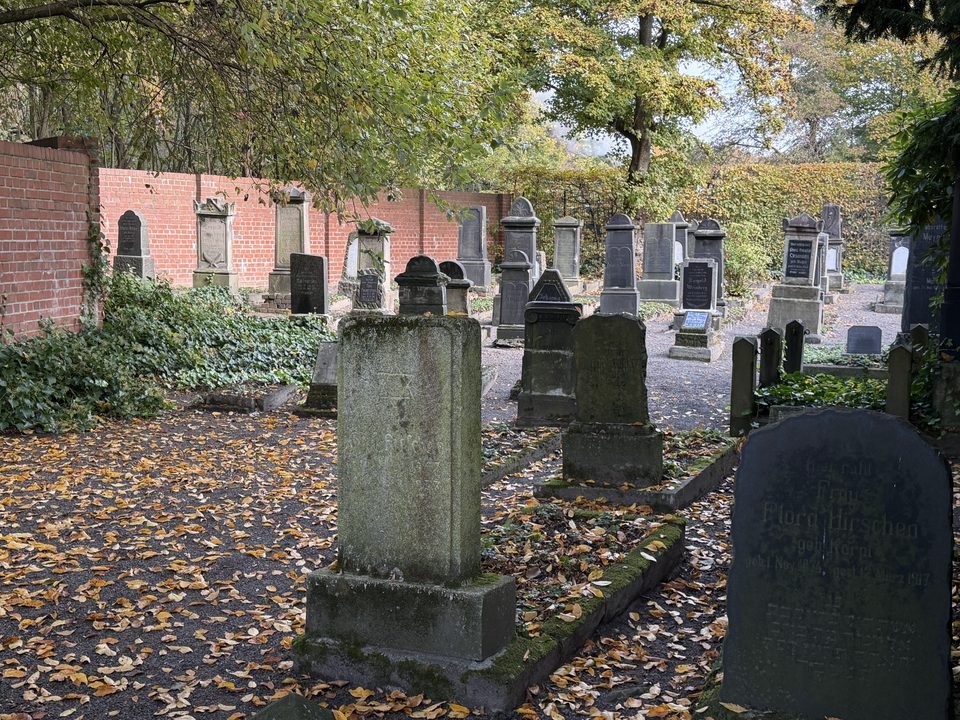
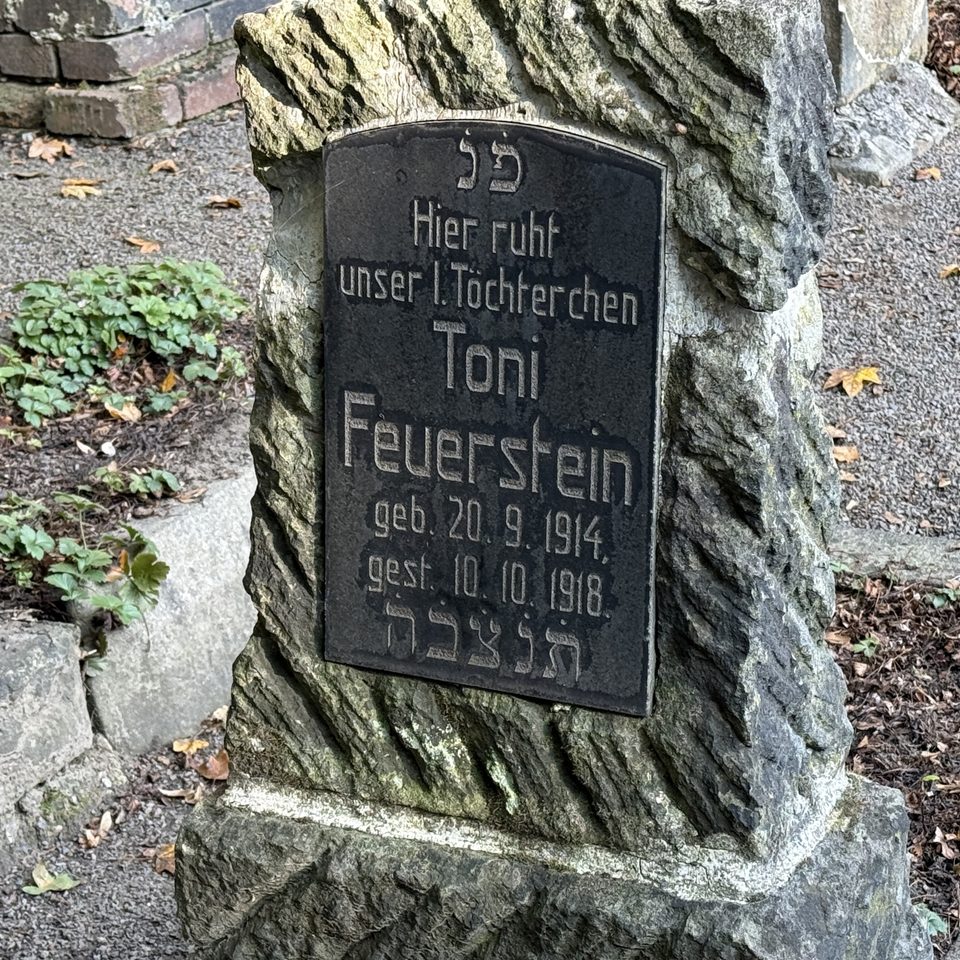
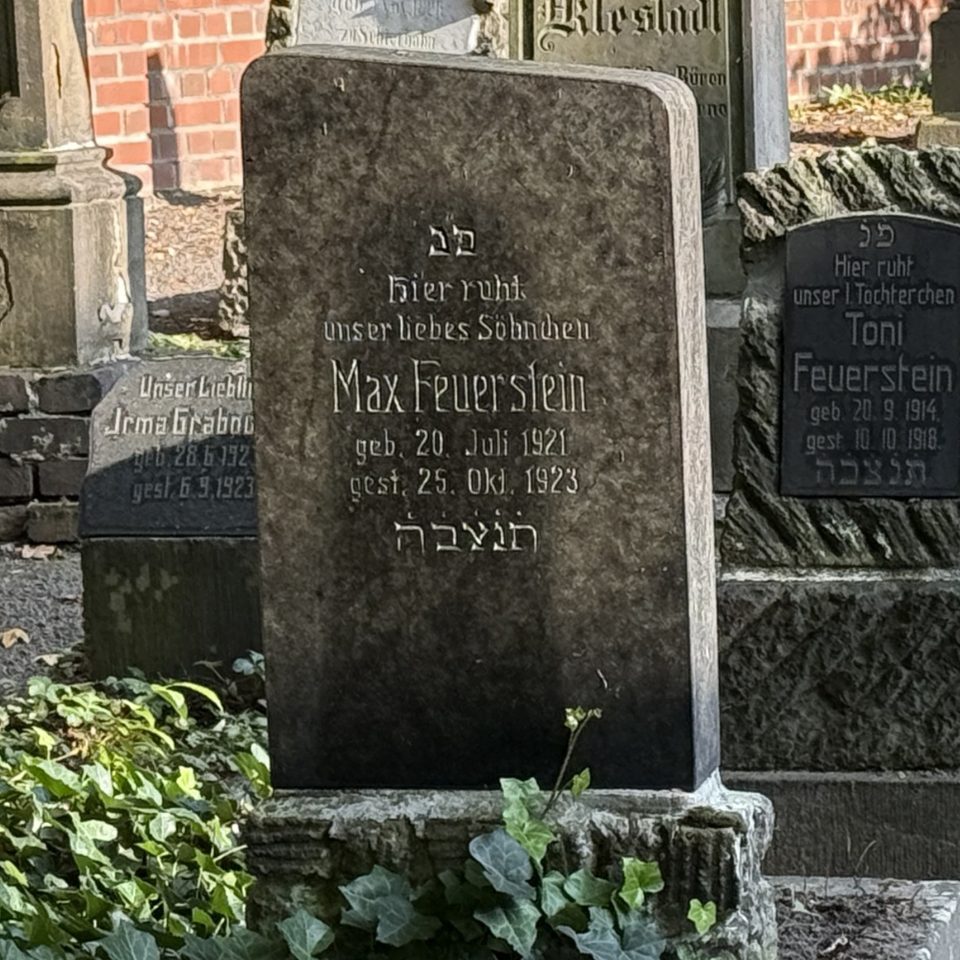
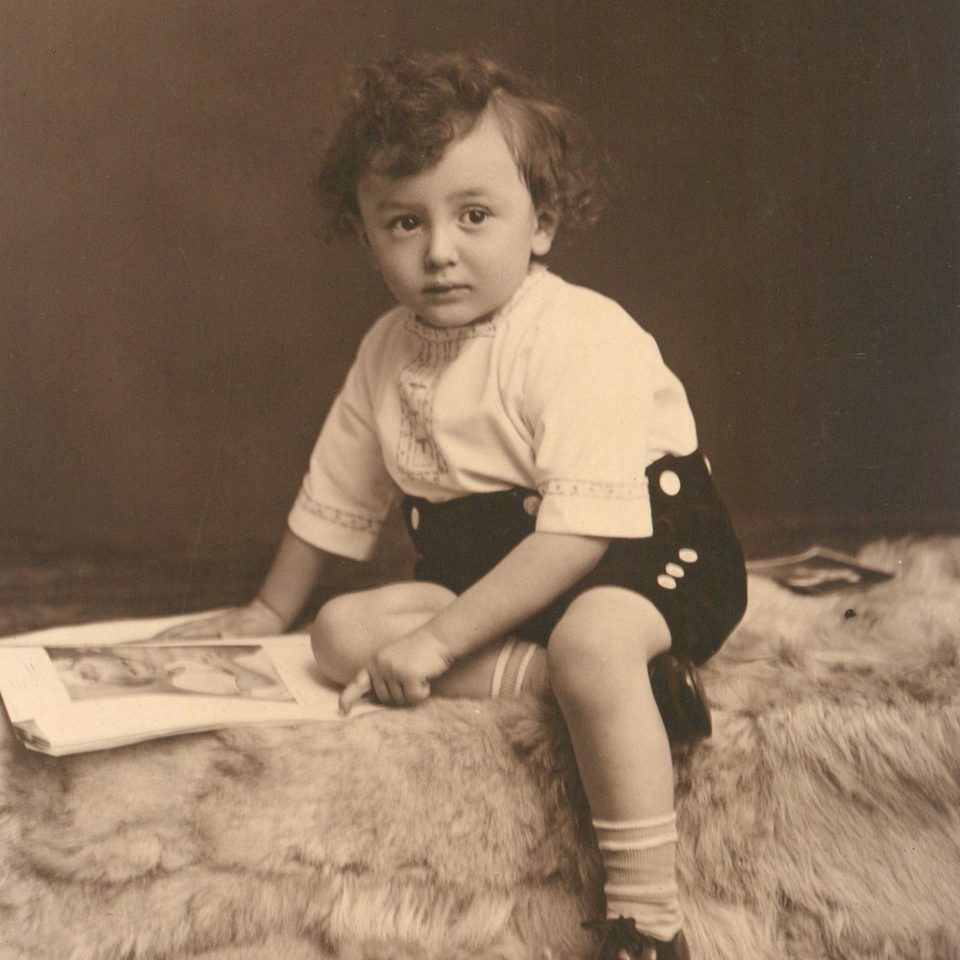
The cemetery is small, and we quickly found the graves of the two Feuerstein children: Toni, a daughter born in September 1914 who died at the age of four in October 1918, and Max, a son born in July 1921 who died at the age of two in October 1923. Opa was away fighting in World War I when Toni died and learned of her death only when he returned home.
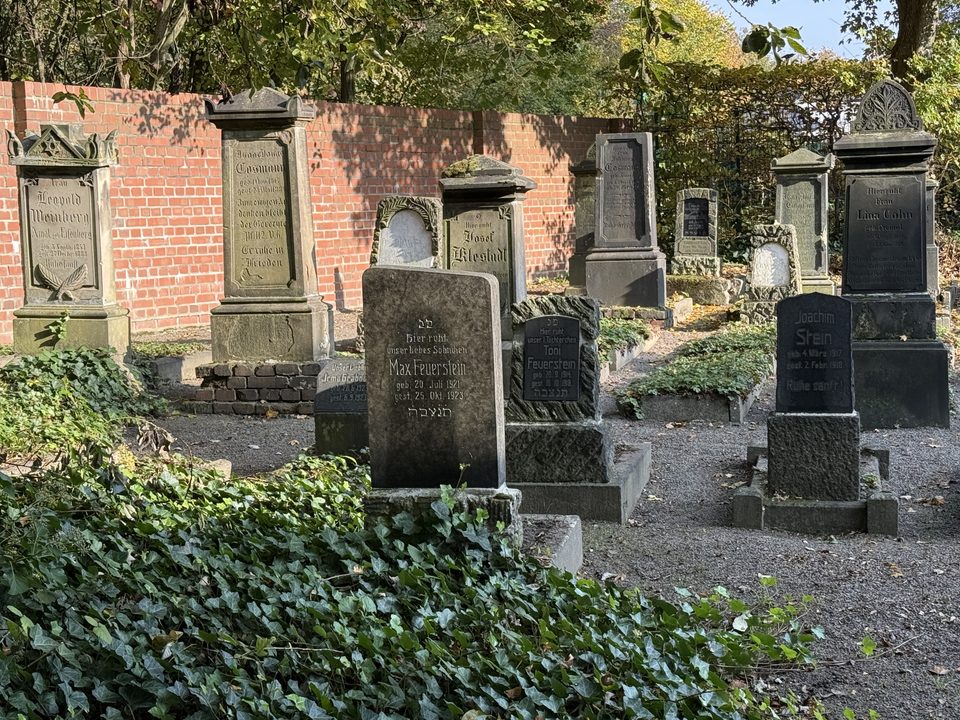
Beyond what we learned about our own family, the cemetery offered a glimpse into the wider Jewish community of Herne. The oldest surviving grave dated from around 1884, and the most recent burial was from 1959. Ralf told us that the last people buried here were two sisters who had survived Auschwitz and settled in Herne after the war.
Familiar surnames appeared repeatedly. Some belonged to families, such as the Kaufmanns, whose businesses we had seen advertised in old newspapers that very morning.
The oldest gravestones bore Hebrew inscriptions and traditional Jewish symbols, such as the raised hands of the Kohanim giving the priestly blessing. Later stones increasingly resembled those in non-Jewish cemeteries, some with inscriptions entirely in German—a reflection of the community’s growing assimilation into German society.
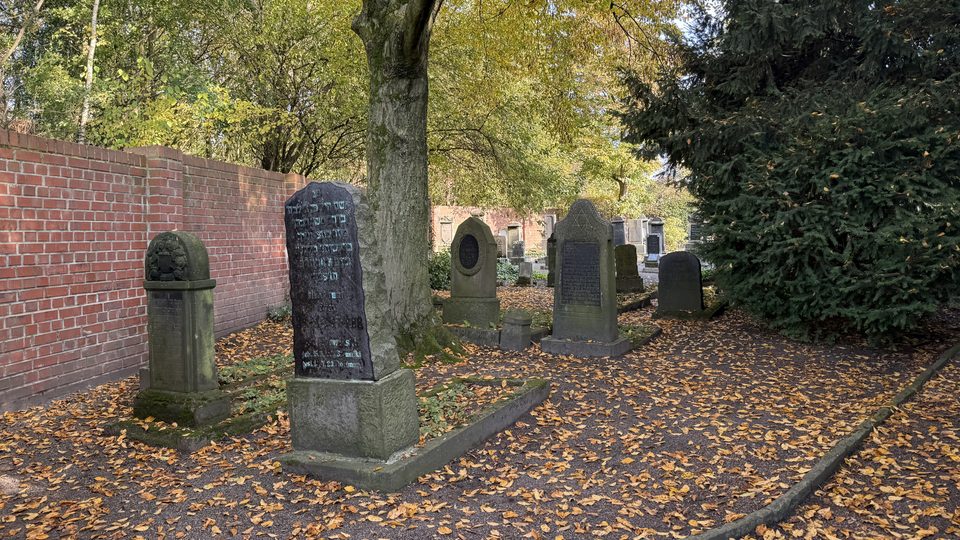
As we walked among the tombstones, Ralf pointed out family plots intended for several generations but containing only a single grave. Other family members had emigrated or been deported and murdered. They would never be buried beside their relatives.
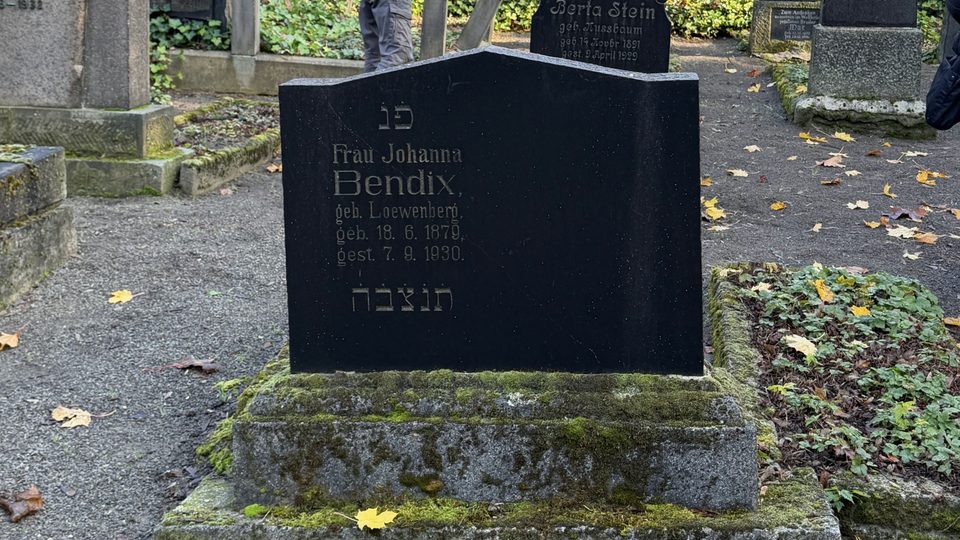
We also saw traces of what had been taken from the cemetery. Some gravestones had inscriptions formed from metal letters attached to the stone. During the Nazi period, these metal letters were stripped from the gravestones to be melted down for the war effort. Where records survived, names could later be restored, but for some, the original details are lost.
Today, preserving the cemetery involves repairing the effects of both weather and deliberate destruction. A set of photographs taken in 1984, documenting every grave, provides an invaluable reference for reading faded inscriptions and restoring damaged stones.
The cemetery has been desecrated several times over the years, most recently, Ralf told us, in 2011. Neighbors now help keep watch and report problems, and police patrol the area several times a day.
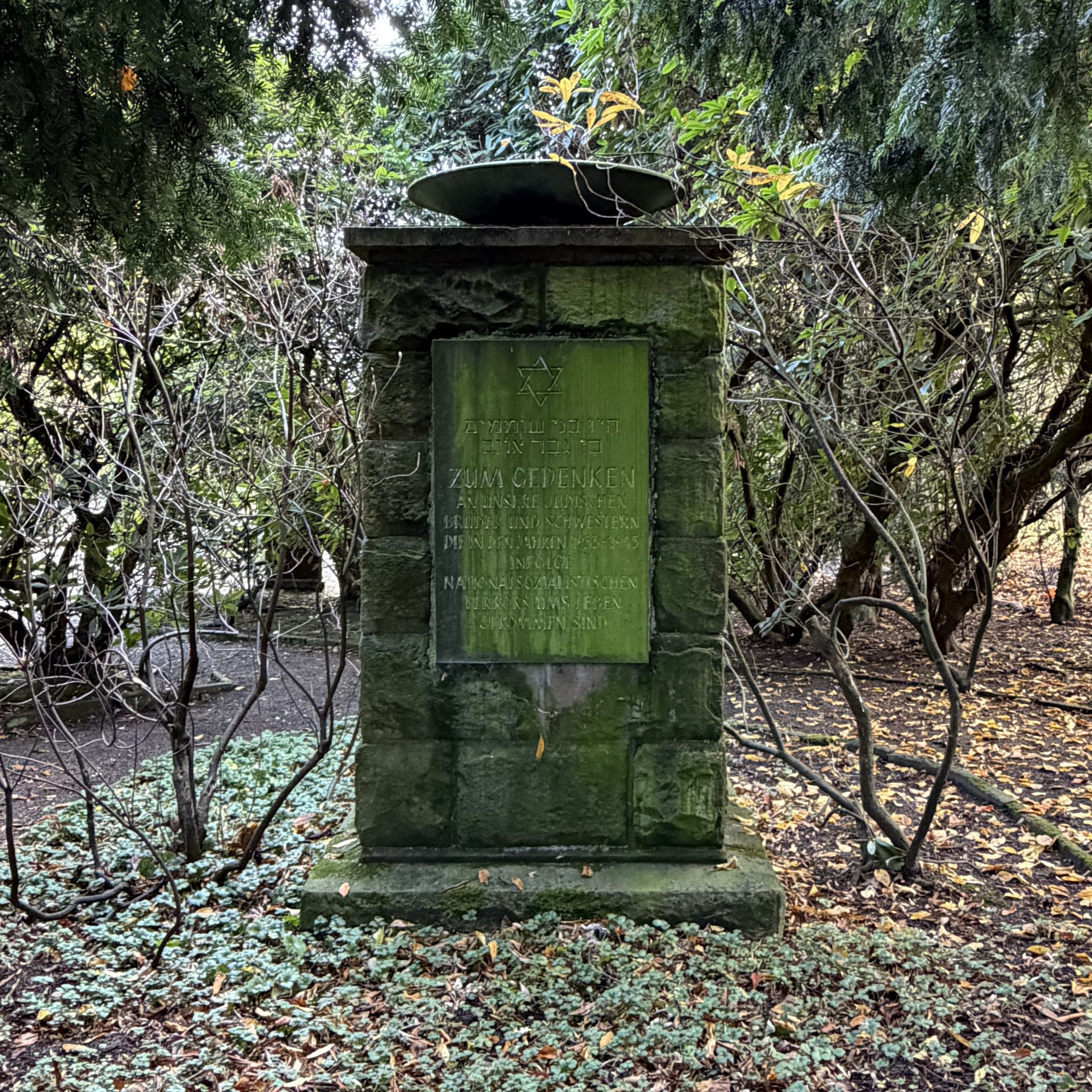
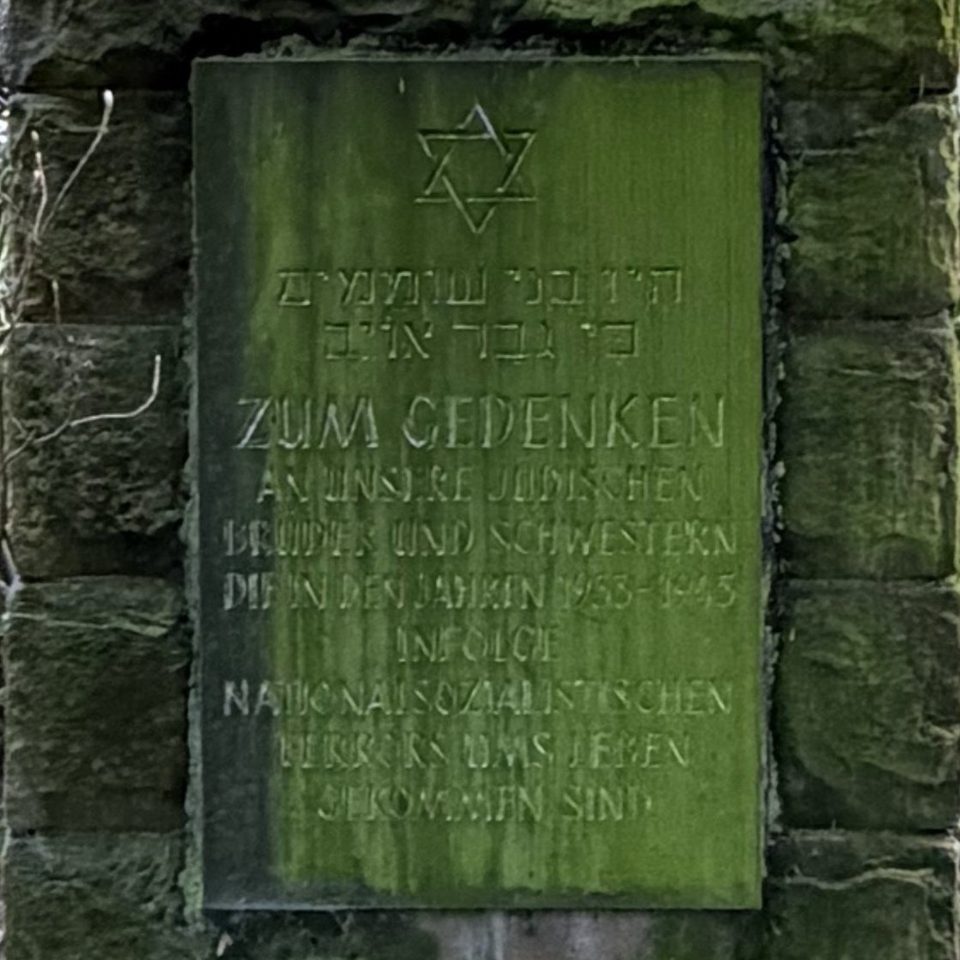
Before leaving, nestled among the trees of the Jewish cemetery, we saw a holocaust memorial. It had originally stood in a square in central Herne, where it was erected in 1949 to commemorate victims of Nazism more broadly. A few years later, redevelopment displaced it. Rather than let it be discarded, the small Jewish community accepted it for their cemetery and added a plaque commemorating Jewish victims. It had not originally been designed as a Jewish memorial, but the community made this monument their own.
Today’s meeting with Ralf had come to an end, and now it was time to return to our Airbnb and get ready for what came next: a gathering of the family members who had come for the Stolpersteine ceremony, followed by a tribute to Gunter Demnig, the artist who created the Stolpersteine project. More about those events in Herne, Germany – Part 2.