AUGUST 24, 2026: In November, we have a family event in Europe. Since we will already be there, we decided to extend the trip and spend a month doing research for Wandering Jew.
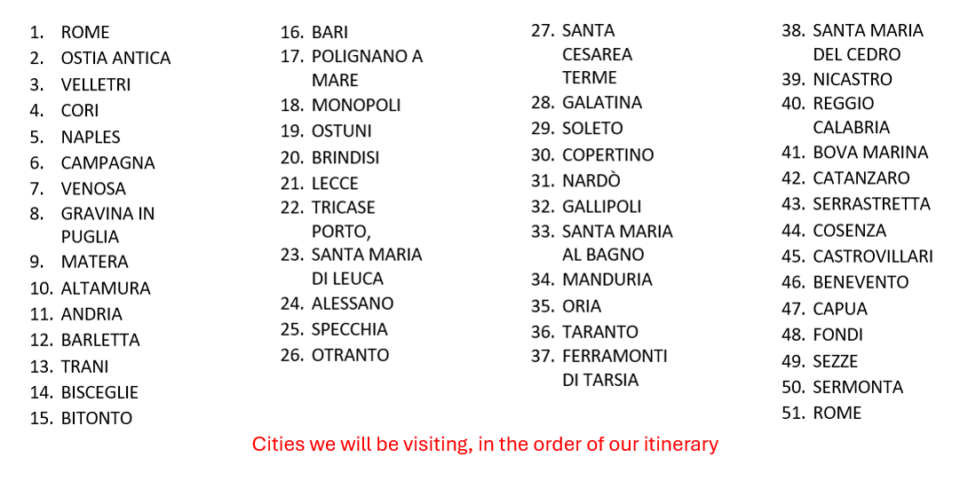
Looking for relatively warmer weather, we chose to concentrate on Southern Italy. With the help of AI, the trip-planning process was much faster. In just a few intense days, I was able to map out the entire route in detail, focusing on towns and sites connected to Jewish heritage.
This will definitely not be a restful vacation. It is a research trip with many goals and a very ambitious schedule. Over 29 days, we plan to visit 50 towns, many with multiple Jewish sites to explore. With the short daylight hours of November and December, fitting everything in is even more challenging.
Every place on our itinerary falls into at least one of the following six categories, with just one exception.
Category One – Ancient and Early Jewish Communities
Jewish history in Italy stretches back more than 2,200 years. The earliest firmly documented Jewish community was established in Rome by the 2nd century BCE.
The first Jews arrived centuries before the birth of Christianity. Some came as merchants and diplomats from the eastern Mediterranean, while others were brought to Italy as captives following Roman military campaigns in Judea. By the early years of the Roman Empire, Jewish communities had become established not only in Rome, but also in ports and trading centers throughout southern Italy.
Southern Italy eventually became one of the important centers of Jewish life in the Roman world. On this trip, we plan to visit archaeological remains from three of these ancient communities.
At Ostia Antica, Rome’s great port city, we will see the remains of one of the oldest known synagogues in Europe. In Venosa, we plan to visit the remarkable Jewish catacombs, with tombs and inscriptions dating back to late antiquity. And at Bova Marina, near the very southern tip of mainland Italy, we will see the remains of an ancient synagogue with its distinctive mosaic floor.
These three sites will take us back to some of the earliest chapters of Jewish life in Italy — long before the sites that make up much of the rest of our journey.
Category Two – Medieval Jewish Communities
This is by far the largest category on our itinerary, with at least 34 towns belonging to it.
During the Middle Ages, Jewish communities flourished throughout Italy, particularly in the south, where Jews worked as merchants, doctors, artisans, scholars, and moneylenders. Many lived in distinct Jewish quarters known as Giudecche. Southern Italy also became an important center of Jewish learning, with significant communities in places such as Oria, Bari, Otranto, and Trani.
Conditions varied greatly depending on the ruler and the period, with times of relative tolerance alternating with restrictions and persecution. By the late 15th and early 16th centuries, expulsions under Spanish rule brought centuries of established Jewish life in much of southern Italy to an end. In most of these towns, very little remains today. We may find only the approximate location of the former Jewish quarter, a street still called Via Giudecca, or, occasionally, partial remains of a synagogue.
Category Three – Towns with Established Jewish Communities Immediately Before WWII
This category is surprisingly short. Of all the towns on our itinerary, only Rome, Naples, and Bari had clearly established Jewish communities in the years immediately before World War II.
Rome, of course, had a large and continuous Jewish community dating back more than two thousand years and remained the most important center of Jewish life in Italy.
Naples had a substantial modern Jewish community as well, with nearly 1,000 Jews in the 1920s and early 1930s, along with an established synagogue and organized communal life. The community declined sharply after the Fascist racial laws were introduced in 1938.
Bari had a much smaller, but still identifiable, Jewish population. The 1938 census recorded approximately 95 Jews in 35 families in Bari city and province, many of whom left after the racial laws made Jewish life increasingly difficult.
Category Four – WWII Jewish Internment Camps
After Italy entered World War II in 1940, the Fascist government established internment camps for foreign Jews, political prisoners, and other people considered undesirable by the regime. Conditions varied greatly from camp to camp and were generally very different from those in Nazi concentration camps, but internees were deprived of their freedom and forced to live under wartime restrictions and uncertainty.
We will be visiting two places in this category: Campagna and Ferramonti di Tarsia.
Category 5 – Postwar Jewish DP and Transit Camps
After World War II, Italy became especially important because of its geography. Its long coastline and proximity to the Mediterranean made it a major southern route for Jewish survivors trying to leave Europe, particularly those hoping to reach Palestine. As a result, numerous DP and transit camps were established throughout the country.
A DP camp — Displaced Persons camp — was primarily a place where people uprooted by the war lived while waiting to rebuild their lives. Jewish survivors, former concentration-camp prisoners, refugees, and others who could not or did not want to return home often remained in these camps for months or even years. Many developed into substantial temporary communities, with schools, synagogues, newspapers, political organizations, cultural activities, and social institutions.
A transit camp, by contrast, was intended mainly as a temporary stopping point on the way somewhere else. Refugees stayed there while waiting for transportation, immigration papers, medical clearance, a ship, or transfer to another camp or country. In postwar Italy, many Jewish refugees passed through transit camps while trying to reach Palestine, the United States, Canada, Australia, and other destinations.
In practice, however, the distinction was often blurred. Some Italian camps functioned as both DP camps and transit centers, either at different times or simultaneously.
During our trip, we will visit at least seven places connected with these postwar Jewish camps. At some, almost nothing remains today; at others, surviving buildings, inscriptions, museums, and memorials preserve the story of the thousands of Jewish survivors who passed through southern Italy on their way toward new lives.
Category 6 – Current Jewish communities
UCEI, the Unione delle Comunità Ebraiche Italiane — the Union of Italian Jewish Communities, is the official umbrella organization representing recognized Jewish communities in Italy. In our itinerary, only Rome and Naples are on its list of 21 recognized communities. However, several other towns we will be visiting, such as Trani, Taranto, Matera, and Reggio Calabria have branches affiliated with the Jewish Community of Naples.
Another town, Serrastretta has an active Reconstructionist congregation, Ner Tamid del Sud, and is not affiliated with the Naples/UCEI community.
In these smaller towns, present-day organized Jewish life is a revival, not a continuation of a prewar community.
The One Exception
There is one place on our itinerary that does not fit neatly into any of these categories, yet has a strong Jewish connection: Santa Maria del Cedro. This small town on Italy’s southwest coast is famous for cultivating the cedro (citron), a variety traditionally sought by Jews for use as the etrog during Sukkot. For generations, rabbis and Jewish merchants have traveled to this region to select suitable fruit. The local Museo del Cedro (Citron Museum) documents both the cultivation of the citron and its long-standing connection to Jewish religious tradition.
Italy is one of the world’s great tourist destinations, yet much of the route we are about to travel goes through places that receive only a tiny fraction of those visitors. Many of our 50 towns are far removed from the standard tourist circuit. Traveling off-season, will only add to the complexity. I can’t wait!
Can you simply love complexity?